Linguistic Foresight
语言前瞻
Before acting, the policy describes the likely outcome of moving forward, turning left, turning right, or stopping—then chooses deliberately.
执行动作前,策略先描述前进、左转、右转与停止各自可能带来的后果,再做出有依据的选择。
LookStep gives embodied agents linguistic foresight and event-driven memory—so every action is informed by what may happen next and what mattered before.
LookStep 为具身智能体注入语言前瞻与事件驱动记忆,让每个动作同时基于“接下来可能发生什么”和“此前什么最重要”。
“Go forward and turn left when approaching the cardboard box and you will see a room, Then enter the room then stop.”
“向前走,在接近纸箱时左转,你会看到一个房间。进入房间后停下。”
Linguistic future-state modeling evaluates candidate actions, while event-driven rolling memory preserves critical observations for long-horizon navigation.
语言未来状态建模评估候选动作,事件驱动滚动记忆保留长程导航中的关键观察。
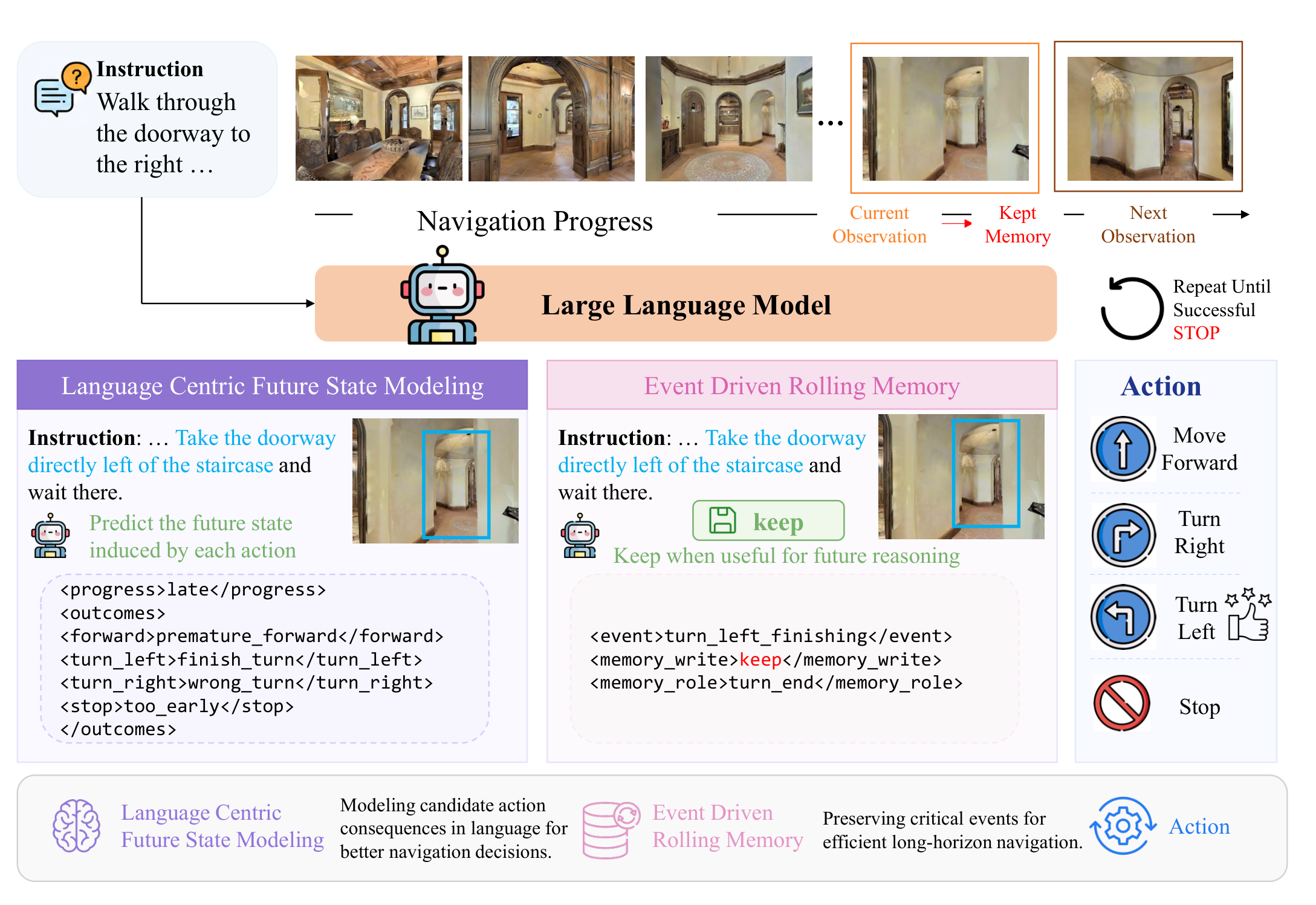
LookStep turns navigation from reactive action selection into structured reasoning over future outcomes and meaningful visual events.
LookStep 将被动的动作选择转化为对未来后果与关键视觉事件的结构化推理。
Before acting, the policy describes the likely outcome of moving forward, turning left, turning right, or stopping—then chooses deliberately.
执行动作前,策略先描述前进、左转、右转与停止各自可能带来的后果,再做出有依据的选择。
A compact FIFO memory preserves navigational events such as turn boundaries, goal approach, and stop evidence instead of storing every frame.
紧凑的 FIFO 记忆只保留转弯边界、接近目标和停止证据等导航事件,而不是无差别保存每一帧。
Reported R2R-CE Val-Unseen performance under the released LookStep evaluation recipe.
使用已发布 LookStep 评测配置得到的 R2R-CE Val-Unseen 主结果。
View reproduction guide查看复现指南NE is reported in meters; OSR, SR, and SPL are percentages. Lower NE is better; higher is better for all other navigation metrics.
NE 的单位为米;OSR、SR 和 SPL 为百分比。NE 越低越好,其余导航指标越高越好。
@inproceedings{lookstep,
  title     = {LookStep: Efficient Vision-Language Navigation with Linguistic Foresight and Event Driven Memory},
  author    = {Kun-Yang Yu and Yingzhe Li and Hongyu Xu and Shi-Yu Tian and Zhi Zhou and Yang Chen and Ming Yang and Sheng Wang and Qing Yu and Lan-Zhe Guo and Yu-Feng Li},
  booktitle = {The 2026 Conference on Empirical Methods in Natural Language Processing},
  year      = {2026}
}